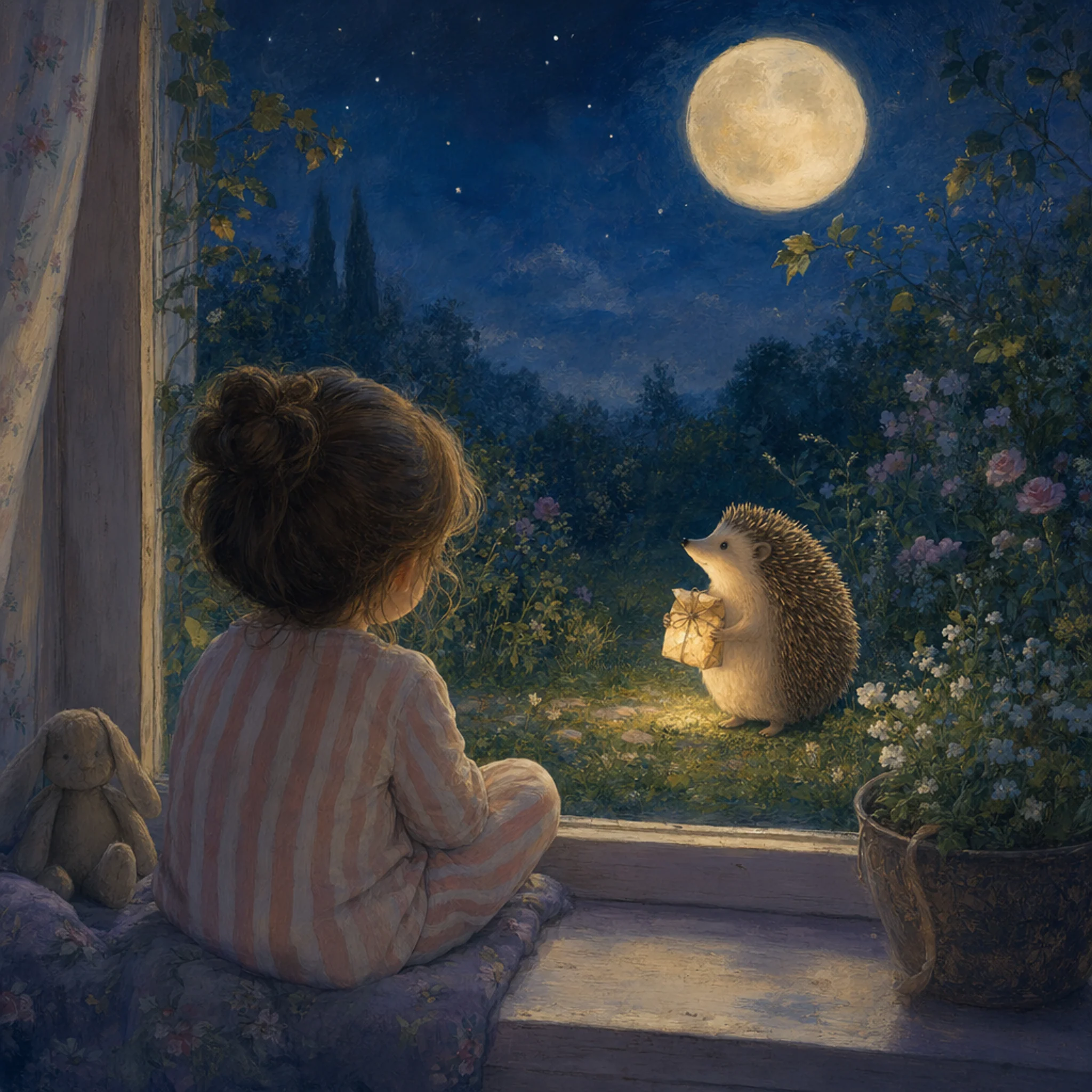
Maya was the kind of girl who asked why about nearly everything, including things that did not seem to need asking, like why oatmeal was gray and figs were purple and strawberries were red, when they all grew out of the same brown dirt.
Every night before bed, her grandmother made her a little bowl of oatmeal with sliced strawberries and torn-up figs on top, and every night Maya ate around the edges first, saving the fruit for last, the way you save the best part of a story.
One night, while she was saving her last strawberry, Maya saw a mouse on the windowsill. It was small and grey and it was looking at her bowl the way Maya looked at the last cookie on a plate.
"Are you hungry?" Maya asked, because that seemed like the important question.
The mouse did not answer, but it did point one paw at the moon, which was full and low and sitting right in the window like it wanted to see the bowl too.
"Does the moon get hungry?" Maya asked her grandmother, who was drying a pot by the sink.
Her grandmother thought about it the way she thought about most of Maya's questions, slowly, like stirring something thick. "The moon doesn't eat food," she said. "But every night, it collects one sweet thing from somewhere in the world, and one plain thing, and it carries them across the sky until morning."
"Why?" said Maya.
"So the night has a little bit of both. Something soft and plain to lean on. Something sweet to look forward to."
Maya looked at her bowl. The oatmeal was the plain thing, gray and warm and always there. The strawberries and figs were the sweet things, and they were never the same twice, because sometimes it was strawberries, and sometimes it was figs, and once, gloriously, it had been both.
She looked at the mouse. The mouse was plain and gray too, like the oatmeal, but its whiskers caught the moonlight and turned silver, which felt like the sweet part.
Maya broke her last strawberry in half and put one piece on the windowsill. She put a torn corner of fig next to it. The mouse crept forward and touched the strawberry with its nose, then sat back on its heels, satisfied, the way Maya sat back after a good bite.
"So the moon takes them from here?" Maya asked.
"Every window it passes," said her grandmother. "One plain, one sweet. That's why some nights feel ordinary and some feel like something extra happened, even if nothing much did."
Maya thought about all the plain parts of her day — putting on socks, waiting for the bath to fill, walking the long way to the kitchen because the rug was soft there. And the sweet parts — the mouse's silver whiskers, the fig that tasted like a tiny warm afternoon, the strawberry top shaped like a little green star.
She understood, finally, why the bowl always had both. Not because plain things were boring and sweet things were better. Because a night needed one to hold up the other, the way a spoon needs a bowl.
Maya climbed into bed and looked out at the moon, fuller now, she thought, than it had been an hour ago — heavier, like it was carrying something.
On the windowsill, the mouse curled into a comma inside an old matchbox her grandmother had left out for it. Maya lined up her strawberry top and the fig stem beside it, plain and sweet, side by side, and pulled her blanket up to her chin, listening to the whole quiet house lean into the dark together.